
Efficient matching of candidates to vacancies with our automated classification model
Olympia

We build AI agents and applications that work within your workflow, and manage them. For Olympia, we built a classification model for matching.
Olympia, which operates in the temporary staffing sector, wanted to use a data-driven approach to match candidates with suitable job openings more efficiently and accurately. The aim was to improve its workflow and the service it provides to candidates and clients. We developed an automated classification model for this.
At a provincial authority, grid operator or healthcare organisation, applications, invoices and questions pass through the same hands every day. An agent or model can read them, classify them and suggest a response. A member of staff decides what matters.
For Olympia, we developed a classification model to match candidates with job openings more efficiently as part of their workflow.
For Fokker Services Group, we built Anthony Chat, which uses a RAG model to retrieve answers from internal documents.
For Fokker Services Group, an AI model predicts the expected invoice amount, and a dashboard highlights significant discrepancies.
We maintain what we build: updating prompts and models, monitoring quality and making adjustments when the process changes.
Which step does AI take over, which decision stays with an employee, and how do they see the proposal?
We build the agent or model and initially run it alongside the existing workflow.
When it goes live, logging, monitoring and an owner are in place. We also agree who handles ongoing management: your team or ours.
Staff read and assess many similar documents every day, such as applications, invoices or CVs, and previous assessments have been recorded so the results can be checked against them.
The rule is fixed and can be fully specified. In that case, a workflow or a rule in your existing system is easier to manage than an agent.
How many systems the agent works with, whether personal data is involved, how many steps it takes independently, where it runs and how much management we handle after launch.
That is why, for decisions that matter, it makes a recommendation rather than a final decision. Every step is logged, so you can see what it did and a staff member can intervene.
Choose this if your case management system, ERP or CRM already handles the task with a built-in AI feature, and it is clear where the data is stored.
Choose this if your IT or data team can monitor applications in production. We build the agent and hand it over with documentation and tests.
Choose this if the process changes frequently and you have no dedicated team for it. Our advice: agree on how it will be managed before building it, through management and continuous improvement.
Based on Westerdoksdijk in Amsterdam, Data Science Lab has worked with data and AI since 2016 as a Databricks Partner and Microsoft Partner. For organisations in Arnhem and Nijmegen, we work on site or online.
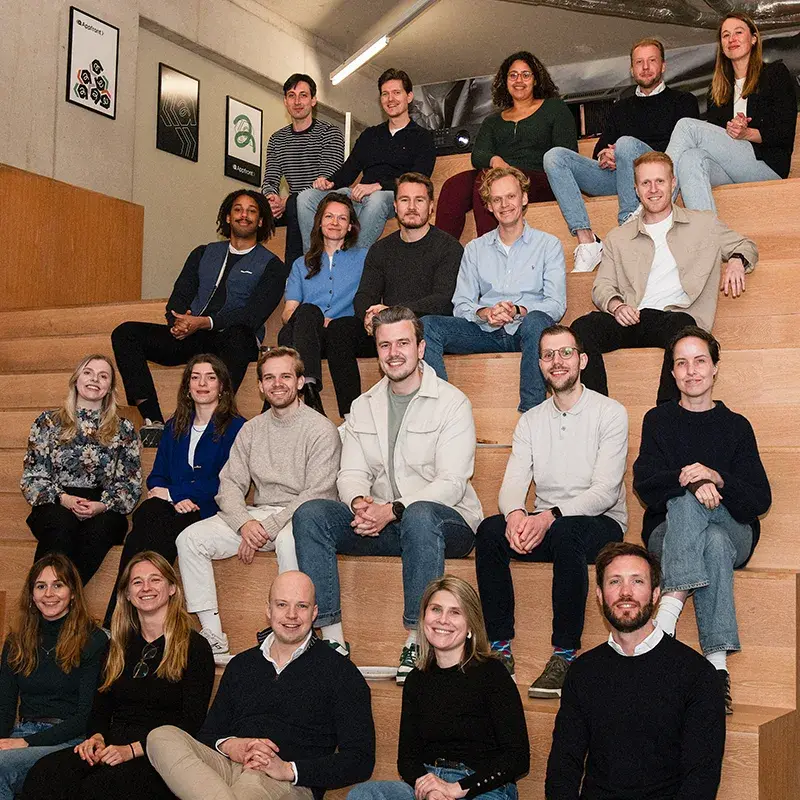
Stef is your first point of contact. In our first conversation, we discuss which step in your workflow AI can take over, in which systems, and who will manage it.
E-mail info@datasciencelab.nl
Phone +31 (0)20 3636 724
Describe the step, the systems and documents involved, and who currently makes the decision. We’ll reply by email or arrange an initial conversation.
Message sent
Thanks for your message. We’ll be in touch as soon as possible.
An AI agency builds applications that use language, documents or data to carry out or prepare a step in a workflow, then keeps them running. We do this as part of our AI applications.
If you need a predictive model, take a look at our data science agency in Arnhem. For advice on where AI is worthwhile, see AI consultant Arnhem.
No. We mention the Olympia case study as an example of a model embedded in a workflow: matching candidates and job openings with a classification model. We have not yet published a case study from Gelderland.
For organisations in Arnhem and Nijmegen, we work on site or online from our office on Westerdoksdijk in Amsterdam.
Automation follows fixed rules: if this, then that. An AI agent uses a language model to break a task into steps, use tools such as a search function or a connection to a system, and choose the next step itself. That makes it useful for a wider range of tasks, but also harder to predict.
Read more about agents under agentic AI.
By defining, for each step, what the agent can do independently and what must remain a proposal. It might be allowed to code an invoice, for example, but not to approve a payment. Every call and decision is logged, and exceptional cases go to an employee.
That is also how invoice checking works for Fokker Services Group: employees now only need to check the exceptions.
Article 4 requires providers and deployers of AI systems to take measures to support their staff’s AI literacy, taking account of their knowledge, experience and the context of use. This is how it reads in the amended text as at 27 July 2026.
Your legal adviser can interpret what this means for you. We help with training and adoption for the people working with the agent.
Arnhem is home to TenneT’s Dutch headquarters, Alliander and Gelderland’s provincial government offices on the Markt. Organisations like these receive requests, reports and documents every day that someone has to read and pass on.
An agent can read a document, extract the information and propose how to handle it. Whether that is permitted and worthwhile needs to be assessed for each process.
We agree on that in advance. Management means updating prompts, models and connections, monitoring quality against a fixed set of examples, and intervening when a system or process changes. Your team can handle this, or we can.
We only manage what we have built ourselves. For models, we use MLOps: version control, monitoring and retraining.
When a task can be handled with a fixed rule or a form, or when there are no documented examples against which to assess the outcome. In that case, start with a conventional workflow or by documenting decisions.
If you first want to find out which task would deliver the most value, start with advice on AI in Arnhem.