
50% fewer manual invoice checks with an AI solution
Fokker Services Group

We integrate AI into your processes, including system integrations, user testing and handover, as we did with AI-powered invoice checking for Fokker Services Group.
Invoice amounts were not always correct, so every invoice was checked manually. Based on the work delivered, our model predicts the expected amount and compares it with the actual amount. Significant discrepancies appear in a dashboard, so staff only need to check the exceptions.
A model in a notebook or a demo with a language model is quick to build. Implementation comes next: connecting it to the systems where the work happens, testing it with the people who will use it, and agreeing who will manage it.
The data the model will receive every day, not just a one-off export. With checks for missing or unusual input.
The technology that fits the task: a predictive model, a classification model or an assistant based on a language model. For NFZ, we built a virtual assistant.
Results appear where the work happens: in a dashboard, an application or an existing system, with a person reviewing exceptions.
Users help test it and know when not to follow its output. Your team then takes over, or we manage it.
One process, a measurable goal and a check that the necessary data will also be available in production.
Build the model or agent, connect it to the systems and test it with users in their day-to-day work.
Move into production with monitoring, guidance for users and agreements on management and continuous improvement.
You have a recurring task or decision, the data it needs exists, and a team wants to use the application and take ownership of it.
You don’t yet know where AI can add value, or no one owns the process. Start by choosing a use case; building without that decision remains an experiment.
The number of systems the application connects to, data quality, whether you use your own model or a language model, privacy requirements, and who will manage it.
Every model does sometimes. That’s why we keep a human in the loop where it matters, measure quality in production, and agree on when to adjust the model.
Choose this if your task is common, such as processing invoices or providing an internal assistant. Start by looking at our solutions that are already available.
Choose this if you have your own data and development team with experience running models in production. We can review your work or provide temporary support.
Choose this if the application is closely tied to your own processes and data. Our advice: start with one process and complete it end to end, including ongoing management.
Data Science Lab has worked with data and AI since 2016. For LUMC, we set up the infrastructure that enabled machine learning models to be deployed in practice. We are a Databricks Partner and Microsoft Partner.
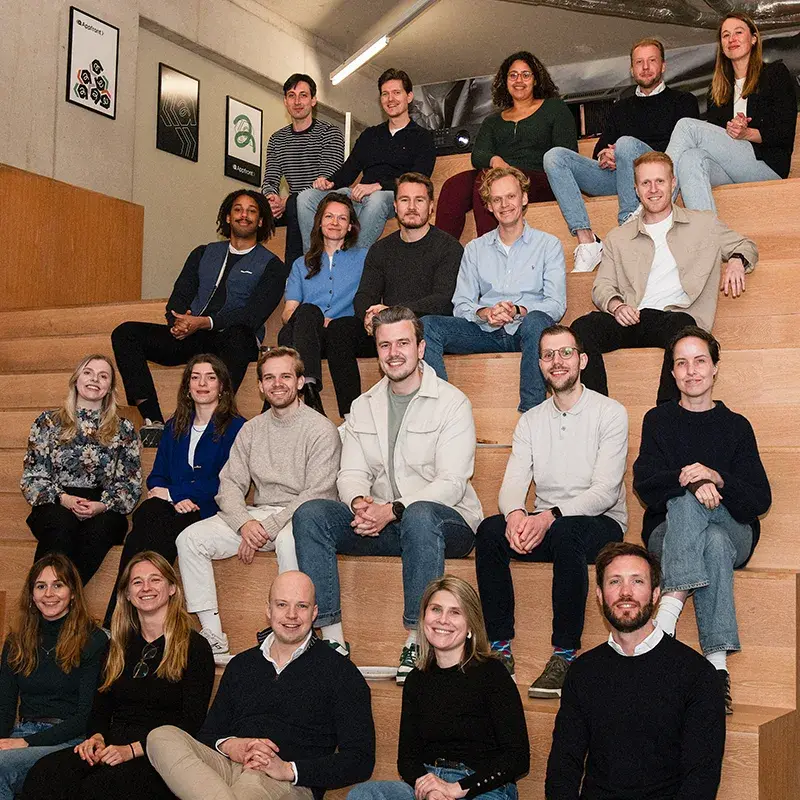
Stef is your first point of contact. In our initial conversation, we’ll discuss your process, data and systems, and what implementation would involve.
E-mail info@datasciencelab.nl
Phone +31 (0)20 3636 724
Tell us which process you want to improve and what you already have in place. We’ll reply by email, or we can arrange an initial conversation.
Message sent
Thanks for your message. We’ll be in touch as soon as possible.
It builds and deploys the application: data, model or agent, integrations, user testing, go-live and handover. That is the work that comes after the advice and the plan.
If you first need help choosing use cases, read about AI consultancy. If you want a plan covering several years, an AI roadmap may be a better fit. You can find all our services on the services page.
Start with one recurring task whose results you can measure. Check that the data will be available in production, not just in an export. Build the model or agent and connect it to the system where the work takes place.
Test it with users in their day-to-day work, agree who owns it and set up monitoring before rolling it out more widely.
A proof of concept shows that something is possible, usually with a fixed dataset. An implementation runs on live data, connects to your systems, has people using it and has someone responsible for managing it.
Many projects stall between the two. The difference is rarely the model; more often, it is the data, the integrations and ownership.
You need versions of the data, code and model, monitoring of prediction quality and changes in the input, and an agreement on when to retrain. For a language model, you also need tests of its answers.
This is called MLOps. Read more on our MLOps page.
They learn what the application does and does not do, how to interpret an output, when not to follow it and who to report an error to. The best time to learn this is while testing it in their own work.
For broader training, we offer courses for management and teams. Read about training and adoption.
Both, depending on the task. Making a prediction from structured data, such as an invoice amount, usually calls for a custom-built model. Answering questions from documents or handling a multi-step workflow is more likely to call for a language model or an agent.
For NFZ, we built a virtual assistant that gives pharmacists access to up-to-date contract information and policy terms.
We agree on that in advance. Your own team can take over with documentation and a handover, or we can keep it running and continue to develop it.
Read about management and continuous improvement. What matters is having someone on your side who owns the application and decides on changes.
When a fixed rule already handles the task well, when the task rarely comes up, or when the data is unavailable and cannot be collected. Without someone who will own and use the application, an implementation will also stall.
In those cases, we will say so and look at whether a simpler solution or better data would deliver more value.