
A clear path towards data-driven working for Nationale Opera & Ballet
Nationale Opera & Ballet

We work through the numbers for an AI application to support a decision, using assumptions you can measure later. For Nationale Opera & Ballet, we linked data to its mission.
"Everything was taken care of for us, and we now have a concrete, actionable plan to keep building towards our data ambitions with Data Science Lab in a focused way." Leon Backbier, Head of I&I, Nationale Opera & Ballet
An enthusiastic demo isn’t a decision. The leadership team wants to know what it will deliver, what it will cost on an ongoing basis and what happens if it falls short. A business case lays this out, with assumptions you can test once the project is under way.
Time per task, fewer errors or more revenue, measured using the figures you already track, as with the growth plan for Nationale Opera & Ballet.
Development, model running costs, management, monitoring and the time employees spend on training and checks.
Every assumption has a metric and an owner, so you can see whether the business case still holds up after launch.
Agree in advance which results mean we continue, make adjustments or stop.
How often the task is carried out now, how long it takes and what errors occur. That’s the baseline.
For each scenario: what changes, what it costs to build and what the ongoing costs are.
A proposal for the management team, with assumptions, metrics and a point at which to decide.
You have identified one or a few promising applications and need to request a budget from management or the board.
You don't yet know which application you want to pursue. Start by identifying and prioritising opportunities; a business case without a defined task is guesswork.
The number of applications, how many of the current metrics are already tracked, and whether you want one scenario or a comparison of approaches.
We then work with a range and put the most uncertain assumption first in the measurement plan. A proof of concept can test that assumption before you go further.
Choose this if the technology is familiar and the main question is whether it will pay off. We recommend this for most applications that require budget approval.
Choose this if no one knows whether a model can handle the task using your data. See AI proof of concept.
Choose this if the expected benefits and the technology are reasonably clear, and you want to see how users work with it.
Data Science Lab has worked with data and AI since 2016, as a Microsoft Partner and Databricks Partner. We advise and build, so we know what managing a solution after go-live involves.
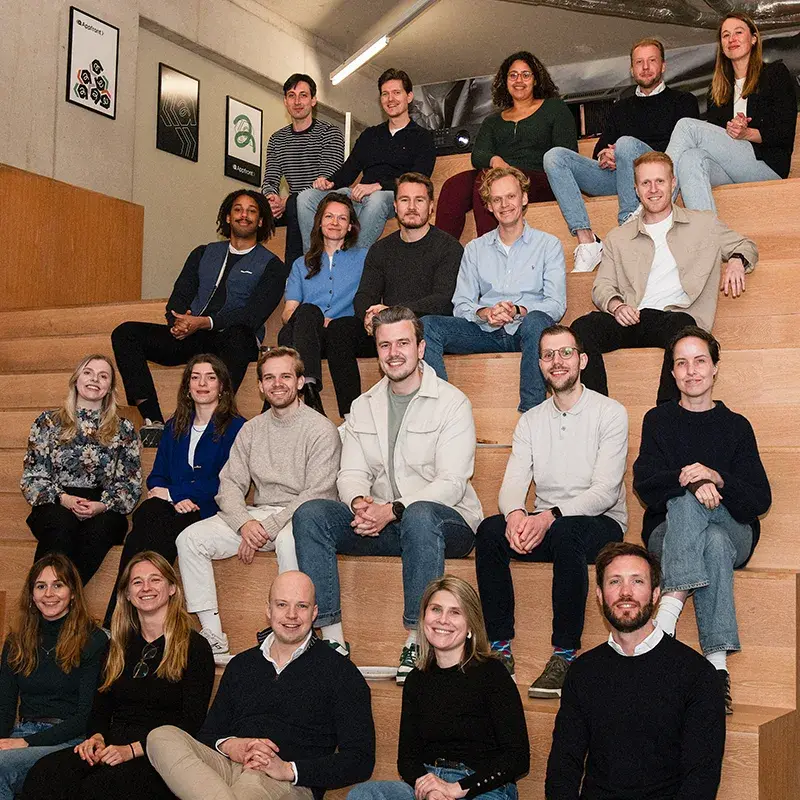
Stef is your point of contact. In the first meeting, we’ll look at which application you’d like to run the numbers on and what figures you already have.
E-mail info@datasciencelab.nl
Phone +31 (0)20 3636 724
Describe the application and who needs to make the decision. We’ll reply by email or arrange an initial conversation.
Message sent
Thanks for your message. We’ll be in touch as soon as possible.
The task and how it is currently done, the expected benefits, all costs from development through to management, the risks, the assumptions and a plan to test them, and a recommendation with a decision point.
It is part of our AI consultancy.
We start with the task: how often does it occur, how much time does it take, and how many errors are made? We then estimate how much of it AI can take over or speed up, and what an employee will still need to do.
Benefits that are not measured in time count too, such as faster responses to customers or reduced risk.
The cost of using a language model for each question or document, monitoring and management after launch, keeping sources up to date, and the time employees spend checking outputs and learning to use the application.
The cost of testing a new model version belongs in the calculation too.
We calculate three scenarios: cautious, expected and favourable. We test the assumption that has the greatest impact on the outcome first, potentially through a proof of concept.
That way, the leadership team knows what risk it is taking.
It varies too much by application to give a single figure. The calculation for an assistant that handles many recurring questions differs from that for a model that reduces a rare but costly risk.
That is why we use figures from your process rather than market averages.
Every assumption has a measure: time per task, number of questions handled, quality of the outcome and usage. We measure these before launch to establish a baseline, then again at set intervals.
If the results differ from expectations, you adjust or stop, as agreed in advance.
No. A business case supports one application or a small group of applications. An AI roadmap puts multiple applications and the data foundation in sequence.
A roadmap often uses the business cases for the first applications as supporting evidence.
They come from identifying opportunities in your organisation and assessing them by value and feasibility. We explain how this works on the Finding AI use cases page.
The business case is the next step for the highest-ranked opportunities.