
Finding football talent faster
Internationaal sportmanagement bureau

We set up models in your own tenant, with networking, roles and costs defined in code. For a sports management agency, we further developed PlayerHub in Azure.
We combined UX/UI and functional design with software development and cloud architecture on Azure, with a focus on security, code reviews and production readiness. This gave the client a foundation to build on, including for future AI features.
A developer creates an Azure OpenAI resource in an afternoon, with a public endpoint and a key in the code. For production, IT wants network controls, roles, logging and a budget for each application. We set these up in advance.
A Foundry resource in a European region, with a standard or EU data zone deployment so prompts are processed in the EU.
Public access is disabled. Traffic runs through a private endpoint in your virtual network, with private DNS and a connection to your existing hub-and-spoke architecture.
Applications authenticate using a managed identity and roles assigned per resource. Any secrets are stored in Key Vault.
For a sports management agency, we further developed PlayerHub, with cloud architecture in Azure and a focus on security and production readiness.
Subscriptions, networking, policies, identity and budgets: what’s already in place, and what’s missing for AI?
Foundry, private endpoints, roles, Key Vault, logging and budget alerts in Terraform or Bicep, for each environment.
One application moves through development, testing and production, connected to your data. Then your team manages it, or we do.
Your organisation already uses Azure, IT wants AI to follow the same network and security rules as everything else, and you’re planning several AI applications.
You don’t have an Azure environment and don’t want one, or your staff only need a chat interface. In that case, a licence for an off-the-shelf product is often enough.
How mature your landing zone is, the number of applications and environments, whether private networks are needed, what data needs connecting and how much management we handle.
Not if you track them by application. Tags, budgets with alerts and quotas per deployment show you what each application uses before the bill arrives.
Choose this if processing must stay within your resource’s geography. Some models may then have limited availability by region.
Choose this if processing within the EU is sufficient and you want more capacity. Our advice: for most European organisations, this offers the best balance.
Choose this for non-sensitive data when speed or model choice takes priority. Processing can then take place in any geography.
Data Science Lab has been operating since 2016 and is a Microsoft Partner and Databricks Partner. We set up Azure data platforms and build AI applications, with a focus on monitoring, security and management.
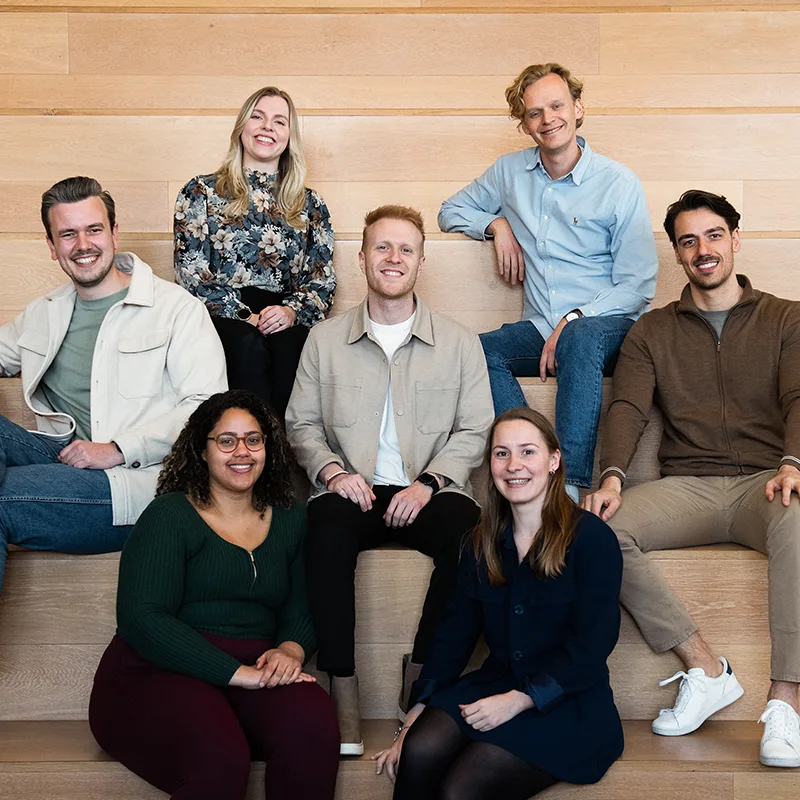
Stef is your point of contact. In our initial conversation, we’ll discuss your Azure environment, the first application and IT requirements.
E-mail info@datasciencelab.nl
Phone +31 (0)20 3636 724
Tell us what your Azure environment looks like and what you want to build. We’ll reply by email or arrange an initial conversation.
Message sent
Thanks for your message. We’ll be in touch as soon as possible.
It means the models, search index and storage are resources in your own Azure tenant and subscription, governed by your network, roles, policies and billing. Microsoft hosts the model, but you decide who can access it and where processing takes place.
Read more about applications in generative AI.
According to Microsoft, prompts, responses and embeddings are not available to OpenAI or other customers, and are not used to train base models without your permission. The models are stateless: prompts are not stored in the model.
With a standard deployment, processing takes place in the geography of your resource. With an EU data zone, processing can take place in any EU member state. With Global, it can take place in any geography where the model runs. According to Microsoft, stored data remains in the chosen geography.
There is automated abuse monitoring. If potential abuse is detected, authorised Microsoft employees may review a sample of prompts. For deployments in the European Economic Area (EEA), the reviewers are based in the EEA. Microsoft is adjusting its arrangements for customised monitoring for new models.
You disable public access and create a private endpoint in your virtual network, with a private DNS zone. Clients on that network use the same name, but connect to a private IP address. From the office, you connect through a VPN or ExpressRoute.
Preferably without API keys: applications authenticate using a managed identity and receive a role on the resource through Entra ID. You can encrypt stored data with your own key in Key Vault.
If you also want to keep your own keys outside Microsoft, read about sovereign AI.
Diagnostic logs and metrics go to Azure Monitor, with a set retention period. Give each application its own deployment or tag, a quota and a budget with an alert, so you can see what usage costs each team.
Yes, if it is also in your tenant: private endpoints and managed identities let you read from your lake or warehouse without copying data outside your environment.
Read about the platform itself in Setting up an Azure data platform.