
Time savings and increased productivity with LLM Anthony Chat
Fokker Services Group

Data Science Lab’s AI engineers work within your team to build applications based on language models, such as the RAG assistant for Fokker Services Group.
"Working with Data Science Lab on projects ranging from market intelligence to AI-driven chat solutions has been invaluable", says Kaveh Alizadeh, Manager Program Management at Fokker Services Group.
The pilot worked in the demo, but with real questions, the model sometimes gives answers that don’t match the documents. There’s no test set or source citations, and no connection to the systems that hold the answers. An AI engineer can build these into your setup as part of your team.
Split and index documents, then use retrieval-augmented generation (RAG) to answer questions about them, as with Anthony Chat for Fokker Services Group.
The assistant draws knowledge from systems already in place, as with the chatbot Dex, which we connected to PostNL’s existing systems.
An LLM can be one step in a data flow, as with the Respect Foundation, where an LLM analysed the sentiment of social media posts.
A test set with real questions, measurements of accuracy and relevance, and measures against prompt injection before an assistant or agent goes live.
We discuss what question the application answers, which documents and systems it draws on, and who will own it.
We introduce colleagues who build with language models. You can speak to them with no obligation and choose who you hire.
The engineer builds in your environment. The code, test set and evaluation results stay with you when the project is complete.
You have a clearly defined question, such as searching handbooks or contracts, the documents are available, and your team wants to learn to build and manage the application itself.
You don’t have a use case yet, or you want a knowledge assistant delivered as a completed project. In that case, a conversation about strategy or a project is a better starting point than extra hands.
The assignment determines how many hours a week the engineer works and for how long; there is no fixed minimum or maximum duration. The rate depends on the expertise required, the engineer’s experience and the length of the assignment.
You’re not hiring a freelancer: the AI engineer is employed by Data Science Lab and seconded to you. Selection, onboarding and follow-up are handled through a single point of contact.
Choose this if your team will retain ownership of the application and wants to learn how to build, test and manage it. We recommend this if you already have your first use case.
Choose this if you want us to deliver a working assistant or agent and take responsibility for it; see generative AI.
Choose this if you expect to keep adding applications based on language models. If our engineer is a good fit, we can discuss hiring them permanently.
Colleagues built the RAG assistant for Fokker Services Group and the Dex chatbot for PostNL. We also have our internal lab and the Techdays. Data Science Lab has been operating since 2016 and is a Databricks Partner and Microsoft Partner.
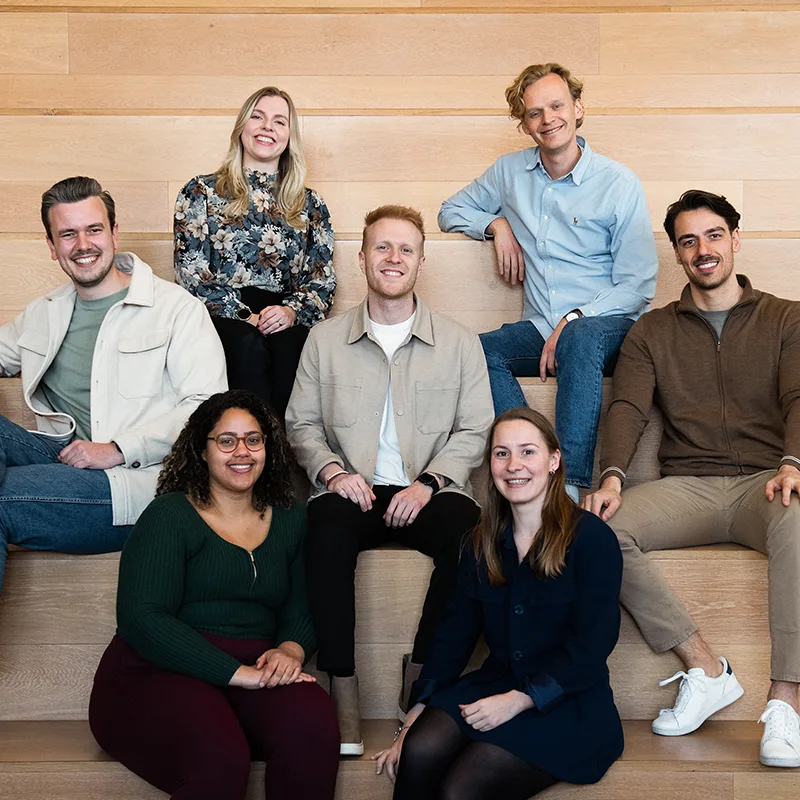
Stef is your first point of contact. In our first conversation, we’ll discuss your use case, your sources and the profile that fits.
E-mail info@datasciencelab.nl
Phone +31 (0)20 3636 724
Tell us about the question, the sources and the team involved. We’ll reply by email or suggest an initial conversation.
Message sent
Thanks for your message. We’ll be in touch as soon as possible.
An AI engineer builds applications on existing language models (LLMs): an assistant that searches your documents, an agent that carries out steps in a workflow, or an LLM used as part of an analysis. They choose the model, build the connections to source systems and test whether the answers are correct.
If you’re looking for a GenAI engineer or LLM engineer, this is usually the same role. Our page on staff augmentation lists the AI engineer among the data science and AI roles.
An AI engineer builds on an existing language model and focuses mainly on sources, prompts, integrations and evaluation. A machine learning engineer trains custom models on your data and puts them into production. An MLOps engineer sets up the processes that keep all models running in production: registry, CI/CD and monitoring.
If you want predictions based on your own data, an ML engineer is the better fit. If you need an assistant to answer questions about documents, choose an AI engineer.
With retrieval-augmented generation, a search step first retrieves relevant passages from your documents. Those documents have already been split into chunks and stored as vectors using an embedding model. The language model formulates an answer based on those passages and cites the source, so you can check it.
At Fokker, we saw two pitfalls: a question with several parts may not retrieve all the relevant passages, and similar contracts for different clients can get mixed up. Splitting questions into parts and using clear metadata helps. Read more in our article on internal LLMs and RAG.
Use a test set of real questions and the answers you expect. For RAG, Microsoft distinguishes between two types of measurement: the search step (does the assistant retrieve the right passages?) and the answer. For the answer, you assess groundedness (does it contain anything that isn’t in the sources?), relevance and completeness.
Another language model can act as a judge and assign these scores. The AI engineer runs the test whenever the prompt, model or index changes, so you can see whether a change improves or breaks anything.
Start with the data you’ll put into it. If your organisation already uses Azure, Azure OpenAI is an obvious option: it comes with a standard data processing agreement, and you can have temporary storage of inputs disabled. Hosting an open model on your own infrastructure gives you the most control, but requires the most work and your own guardrails.
We discuss the trade-offs between privacy, hosting, costs and ease of use in our article how to choose the right LLM.
The biggest risk is prompt injection: text in a question, document or web page that gives the model different instructions. OWASP lists it as the top risk for LLM applications. The risk is greater with agents, which call systems themselves.
Among other measures, OWASP recommends giving the agent only the permissions it needs, marking external content separately, requiring human approval for high-impact actions and actively attacking the application in tests. Read more about agents under agentic AI.
People need to know they’re talking to a machine. According to the European Commission, the AI Act’s transparency rules apply from August 2026. If you use an assistant to make decisions about people, such as screening job applications, it may fall under the stricter rules for high-risk systems.
The AI engineer makes sure that answer sources, versions and tests are recorded. Your legal counsel or compliance team assesses whether an application falls under the rules. Read more under AI governance.
If you don’t yet have a defined use case, an engineer has nothing to build. Start with Data & AI strategy instead. If your documents are outdated or scattered, address the data foundation first. If you need a custom predictive model, a machine learning engineer is a better fit.
If you want an internal knowledge assistant but don’t have your own development team, take a look at Joost, our AI assistant for internal knowledge.
Read how we work with language models and maintenance data at an MRO company in AI in aircraft maintenance and MRO.