
Immediate access to contract information and policy terms at the pharmacy counter with our virtual assistant
Nederlandse Farmaceutische Zorggroep (NFZ)

We build AI applications based on rules and documents that change, and manage them over time. That’s how we built a virtual assistant for NFZ.
“The NFZ Virtuele Assistent has significantly improved our clients’ workflow. Its accurate information and ease of use, made possible in part by good collaboration with DSL’s developers, have made it an indispensable part of our clients’ daily work.” Alberto Fernandez, Project Pharmacist, NFZ
An assistant or model uses contracts, policies and regulations as they stood when it was built. In healthcare organisations, ministries and their partners, these change regularly. Without a defined process for updating its sources, the application can start giving outdated answers without anyone noticing.
For NFZ, we built a virtual assistant using information from contracts with health insurers, so pharmacists have access to up-to-date information throughout the year.
For Harman, we used GenAI and LLM technology to develop a selection process that assesses entries for prize campaigns objectively and reproducibly.
For SNG, we automated the release process through the DTAP pipeline in Google Cloud, making it consistent and controlled.
We can continue to manage what we build: refresh sources, monitor the quality of answers and adapt the application as your work changes.
Which question does the application answer or which task does it take over, and which documents or systems provide the answer?
We build the application and test it against a fixed set of questions with known correct answers.
Before go-live, we establish how sources will be refreshed, how the application will be monitored and who owns each source.
Staff search the same contracts, policies or files every day, or manually review many similar documents. And someone is willing to take ownership of the sources.
The answer is already available in one easy-to-find place, or the rule is fixed enough for a form or decision tree to suffice. In that case, AI mainly adds management work.
The number of sources and systems, how often they change, whether they contain personal or patient data, where the application runs and how much management falls to us after go-live.
The GDPR applies to personal data. In the public sector, the government's position on generative AI also applies. Your privacy officer or legal counsel decides whether the application is permitted. We provide what they need: sources, data flows and logging.
Choose this if an existing product covers your task and the supplier is clear about where your data is stored. You mainly need to manage access rights, data sources and usage.
Choose this if your data team can monitor and update applications in production. We build them and document how sources and versions are tracked.
Choose this if data sources change frequently and you do not have a dedicated team to manage them. Our advice: assign responsibility for management before development begins, through AI Managed Services.
Data Science Lab has worked with data and AI since 2016 and is a Databricks Partner and Microsoft Partner. We can come to you in The Hague or the surrounding area, welcome you at Westerdoksdijk in Amsterdam, or meet online.
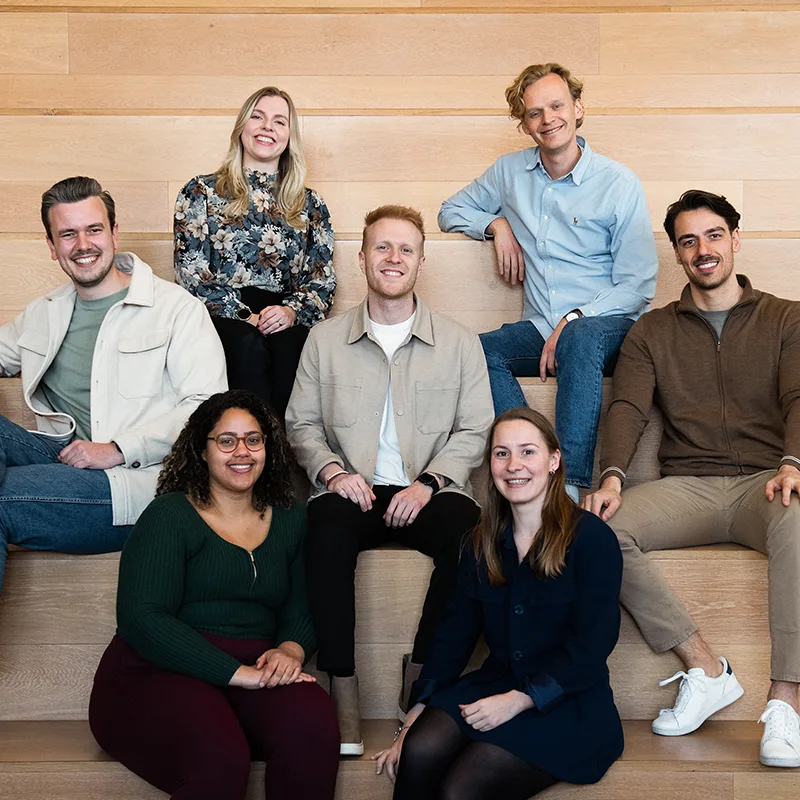
Stef is your first point of contact. In our first conversation, we’ll discuss which task AI should support, which sources it should use and who maintains those sources.
E-mail info@datasciencelab.nl
Phone +31 (0)20 3636 724
Describe the task, the sources your team currently searches and who keeps them up to date. We’ll reply by email or arrange an initial conversation.
Message sent
Thanks for your message. We’ll be in touch as soon as possible.
An AI agency builds applications that use data or language to support a task, then keeps them running. We build these as part of our AI applications.
If you want to validate a predictive model first, see our data science agency in The Hague. If you need advice on which algorithms to use and how to register them, read about our AI consultancy in The Hague.
NFZ connects pharmacists and health insurers. The most important information used to be in an annual pharmacy booklet, but it could change during the year. The assistant contains information from NFZ contracts, supplemented with practical information for pharmacists, and stays up to date.
The case study mentions Microsoft Azure, Python and a blob trigger: code that starts when a new or updated file appears in storage. NFZ is not a client in The Hague; we mention the case study as an example.
By managing its sources as part of the application. For each source, we record who owns it and how a new version is received. After every change, a fixed set of questions with known answers shows whether the application is still accurate.
For models, we also monitor inputs and outcomes and set a point at which to retrain. Read about how we set this up under MLOps.
On 22 April 2025, the Dutch cabinet submitted its government-wide position on the use of generative AI to parliament. According to the Dutch central government, it gives government organisations more scope to use generative AI in their work, subject to conditions, with an emphasis on clear risk assessments and reliable models.
For such a risk assessment, we provide the facts about the application: sources, data flows, the model and logging. Your legal counsel, privacy officer or CIO office decides whether its use is appropriate.
Often, yes. Article 50 of the AI Act requires providers to design AI systems that interact directly with people so that those people know they are dealing with AI, unless this is obvious. According to the European Commission, the transparency rules have applied since August 2026.
Your legal counsel or compliance department handles the legal interpretation. We build in the notification and logging. You can read more about the timeline under AI Act.
The municipality of The Hague’s Port Authority and Control Centre is responsible for the port: traffic on the water, day and night, and the management, maintenance and use of the port area. In the Port Vision published by the municipality on 1 July 2025, it remains a working port, with fishing, water sports and innovation across three harbours.
For a working port like this, the relevant tasks include planning berths, maintenance and traffic. Read about how this works in other ports under AI in ports and maritime operations.
Who owns each source, who approves a new version of the application, what is logged and what staff should do if the application fails or gives an incorrect answer. We also establish whether your team or ours will manage it.
If we manage it, this falls under management and continuous improvement. We only manage solutions we have developed ourselves.
If the answer is already in one place but staff cannot find it, a better search function or a tidier intranet will help. The same applies if you do not yet know which task would deliver the most value. In that case, start with AI advice in The Hague.
If you mainly want a single point of access to your organisation’s internal knowledge, take a look at Joost, our internal AI assistant.