
Time savings and increased productivity with LLM Anthony Chat
Fokker Services Group

We build assistants, agents and document models and manage them too, like Anthony Chat, the internal chatbot we built for Fokker Services Group.
“Working with Data Science Lab on projects ranging from market intelligence to AI-driven chat solutions has been invaluable for deriving smarter business solutions.” Kaveh Alizadeh, Manager Program Management, Fokker Services Group
At local authorities, healthcare organisations and service providers in Haarlem and Kennemerland, staff search policy documents, contracts and invoices every day. An assistant working with your own documents, or an agent that handles a defined step, does the searching; your staff member checks the results and makes the decision.
For Fokker Services Group, we built Anthony Chat: employees ask questions about internal documents and get clear answers through a RAG model.
For Fokker Services Group, our model calculates the expected invoice amount based on the work carried out; large discrepancies appear immediately in a dashboard.
For Respect Foundation, an LLM analysed the sentiment of coverage about Week van Respect, alongside social media monitoring.
For LUMC’s cairelab, we set up MLOps: from experiment tracking and CI/CD to model serving, monitoring and maintenance.
We choose one task that currently involves a lot of searching or manual work, and agree on who will own it.
We test the answers against questions and documents from your own work, together with the people who will use the application.
The application runs in your own environment, with logging, monitoring and an agreement on who makes adjustments.
Employees often search the same documents, or a recurring task follows a set sequence of steps. The sources are digital, and someone is willing to take ownership of the application and keep checking its answers.
The documents are outdated or contradict each other, or the task rarely comes up. In that case, cleaning up the documents or improving search in your existing system will deliver more value, and we’ll tell you so.
How many sources and systems we connect, how many types of questions or documents there are, what access rights apply to each employee, where the application needs to run and who will manage it.
Yes. For LUMC, we worked on on-premises, sovereign infrastructure. Together, we choose a language model and hosting setup that fit your privacy requirements and IT environment.
Choose this when your team needs to find answers across many documents, such as policies, contracts or manuals. The assistant cites its source so your team can check the answer.
Choose this when a task follows set steps across multiple systems, such as logging and forwarding a report. Our advice: start with an agent that makes suggestions, and have a person approve them.
Choose this when you have many previous cases with recorded outcomes, such as invoices and the work behind them. A model can then calculate what to expect and highlight any deviations.
Data Science Lab is a Databricks and Microsoft partner. From our office on Westerdoksdijk, we’ve built assistants and models for organisations including Fokker Services Group and LUMC. At our Techdays, we share what we learn.
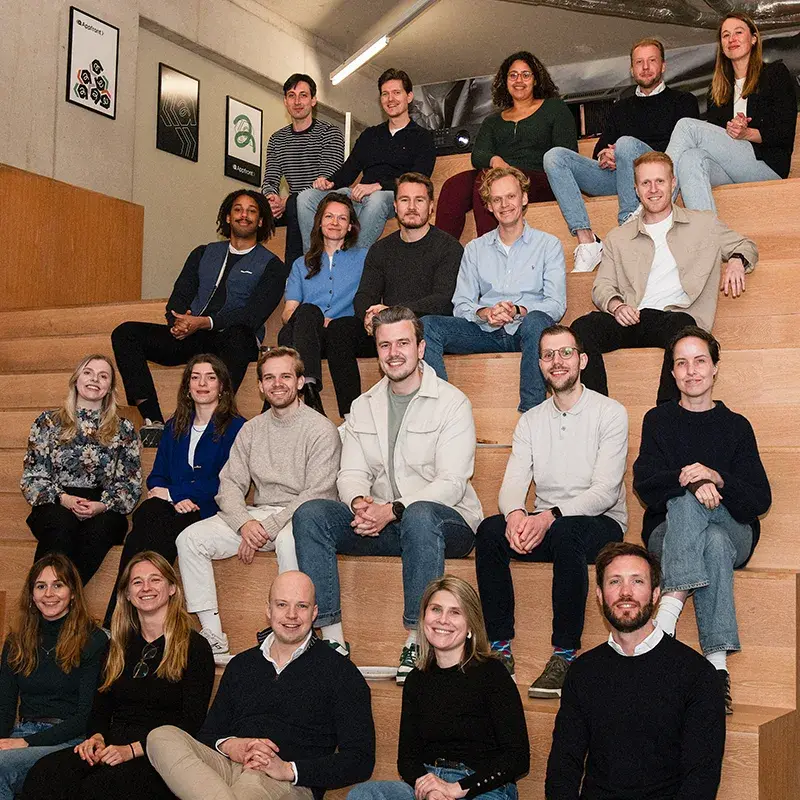
Stef is your first point of contact. In our first conversation, we’ll discuss which task or document-related work should be first in line for an AI application.
E-mail info@datasciencelab.nl
Phone +31 (0)20 3636 724
Describe the task and the documents or systems involved. We’ll reply by email, or arrange an initial meeting.
Message sent
Thanks for your message. We’ll be in touch as soon as possible.
Applications that take over or support a task at work: an assistant that finds answers in your own documents, a model that checks documents, or an agent that handles steps in a process. We then manage them.
If you’re looking for an AI company or AI agency in Haarlem, Data Science Lab has been doing this work since 2016. You can find all types of applications under AI applications.
No. Our office is on Westerdoksdijk in Amsterdam, close to Haarlem. For organisations in Haarlem, Heemstede, Bloemendaal and Zandvoort, we work at your premises, at ours or online.
The case studies on this page are not from Haarlem; they show what we build. You can read more about our work in Amsterdam under AI consultancy Amsterdam.
We use a fixed set of questions that your employees know the correct answers to. We ask them again after every change, checking whether the answers are correct and whether the assistant cites the right source.
Anthony Chat for Fokker Services Group uses Retrieval-Augmented Generation (RAG): the model first retrieves the relevant passages from the documents and only then formulates an answer.
An assistant answers questions; the employee then does the work themselves. An agent also carries out steps, such as looking up information in one system and creating a record in another.
An agent therefore needs more rules: which actions it can take, what a person must approve first, and how you can see what it has done. Read more under agentic AI.
Yes, if there are enough previous cases to learn from. For Fokker Services Group, our model calculates the expected invoice amount based on the work carried out and compares it with the actual amount. Employees only check the exceptions.
If you need to extract information from letters, forms or PDFs, read about document processing with AI.
We agree this before it goes live: who owns it, who gets alerted if the answers deviate, and who approves a new version. Documents, systems and language models change, so ongoing management is part of the work.
For LUMC, this covers everything from experiment tracking to monitoring and maintenance. You can read how it works under MLOps; it can also be handled through management and continuous improvement.
There is overlap. This page focuses on applications used at work: assistants, agents and document models, plus their ongoing management. Our data science consultancy focuses on the model itself, such as a model that predicts or assesses.
For that side of our work, read about our data science consultancy in Haarlem. If you work for a public authority, take a look at the algorithm register too.
When the task rarely comes up, when the documents that should contain the answer are inaccurate, or when nobody wants to take ownership. An assistant then becomes another system to maintain.
Sometimes a cleaned-up set of documents or a fixed rule in your case management system is enough. We’ll tell you that too, before anything is built.